
Category: Longform
You are viewing all posts from this category, beginning with the most recent.
And this is why I mostly avoid engaging in the comment section...
The YouTube algorithm served me a video today of an expat ranking all the countries he’s lived in (quite a few…). At one point, he mentioned that Portugal has gotten much more expensive, offers fewer freebies for expats, and that expats are facing more backlash. I replied, asking whether the rising prices and the backlash might actually be related.
Someone (not the content creator) replied, telling me that people need to stop being delusional. They claimed there are tens of thousands of abandoned properties in the interior of Portugal, and insisted that locals just need to move where they can afford to live, work harder, or train for a better-paying job.
It’s wild how delusional some people are. They completely remove themselves from the equation, view themselves as some kind of “bringer of prosperity,” and genuinely think it’s okay to price locals out of their own hometowns while telling them to move away and stop complaining.
If you want to move abroad, don’t be like this person… Anyway, time to stop feeding the trolls.
How AI made me use pen and paper more
It’s funny how things sometimes have unexpected outcomes. For a long time, I considered myself a digital, keyboard-driven guy. I saw the value of analog—of writing with pen and paper—but I always felt the information was somehow lost, or at least complicated to retrieve. So, for a long time, my entire note-taking process was either on my laptop or my mobile.
Enter AI.
Now, I just take old-school, pen-and-paper notes, scan them with an AI tool, and add them to my Obsidian vault. Obviously, OCR and text recognition aren’t new, but now I can just take a photo and have my scribbles converted into a Markdown file in the exact format I want.
Nowadays, I find myself actually missing my pen and notebook—something that hasn’t happened in years.
If you're posting Micro.blog from Obsidian, this might interest you
If you’ve been using Obsidian and Micro.blog, you might have come across Micro.publish, a plugin that allows you to publish to your blog directly from your vault, with full support for multiple blogs and image handling. Although this plugin was deprecated last year by its author, it still works fine and should remain that way; however, it will obviously lack any new features.
That’s why I started adding my own features to provide further functionality and customization that is useful—at least for me:
- Configurable category property: The default behavior of using the tags property was messing up my vault system. Now, you can specify exactly which property to use for categories.
- Support for a summary field: This was missing entirely, but it is now possible to define a summary for your posts. Similar to the category setting, you can configure which property to use for this field.
This version is not available in the Obsidian community plugins directory. To install it, you must use BRAT, the plugin that allows you to install beta versions. After installing and enabling BRAT, click Add Beta Plugin and enter the URL for my repository: https://github.com/t3mujin/obsidian-microblog.
Flickr app prompted my login again, but it's ok!
Today I opened Flickr app on Android and got suspicious: it asked me to re-enter my login again, and in the current days of scams and phishing this is enough to raise a yellow flag in my head.
Then I understood why, the app had a significant update. Feels nicer now! Great to see it receiving some love, it’s hard to find a place online that’s not over the top, no frills, where someone can see and share some photos, without reels, popups or worries on how much of its audience a person can reach. It’s this simpler and less flashy side of photo sharing that has brought me back there in recent years, after some time of ignoring it (and even considering closing my account).
So if you’re there, feel free to say hi!!
PS- by the way, speaking of Flickr and passwords, it’s about time they implement a tighter authentication model, something that isn’t just password based. And fediverse support would be great also!
Why do I have two newsletters on my photo site?
The shortest answer is because Micro.Blog is forcing me to keep it separate.
But the actual reason is the same why I created two satellites to the main site on Micro.Blog in the first place: Fieldnotes and Just The Photos. One is more for the new stuff and updates, while other for the archive and memories. So it makes sense to keep them separate), specially because the second one, to me, feels like it needs a space on it own, away from the randomness from my updates. But that’s maybe just me being picky.
When configuring the newsletter I got stuck with that decision of creating them separate, having a single one could be interesting, but letting users pick what they want should be fine also. So, for now, you can have my photography updates in your email in two ways: the new stuff as it happens and the memories from my archive.
It's time to rethink your online privacy, if you live in the EU...
The way how Chat Control 1.0 was approved today (after it being rejected twice and using behind-the-scenes tricks to force it to be approved) is a fine example that politicians, when really committed, can get things moving…
It’s is a worring day for privacy in Europe, as it opens way to the very dangerous Chat Control 2.0 that will enforce things like providers having to scan ALL messages and ALL media being transferred.
Not all is lost, as Chat Control 2.0 hasn’t been approved yet, but it’s clearly a turning point, because it’s time to take a stand to block it, but also to start reassessing the tools we use in our online everyday life…
The magic of lingering in the same place
I was doomscrolling through YouTube recently when a photographer recommended that, for street photography, you shouldn’t stay in the same place too long. Just a couple of minutes, he said, so you don’t impose yourself. If you stay in one spot for half an hour, it starts to get weird.
And yes, it’s important to know when it’s time to go. It’s crucial to read a scene and realize when you’re not welcome or when you’re becoming annoying. No one likes that kind of photographer—the one who is full of themselves.
But coming from a very introverted guy who prefers to stay in the corner, the real magic happens when you stay longer. It happens beyond that initial “Who’s this guy and what is he doing here?” phase, or the frenzy of someone with a camera. It happens when you get accepted. That’s when things go back to whatever they were before you arrived, and life starts to happen again. Maybe you end up in the scene, maybe you have a cool conversation, or maybe you get offered a drink.
And that takes time. Often, photography is slow, and it demands patience.
A erosão silenciosa do jornalismo

A Rosália dá dois concertos na MEO Arena, ambos esgotados. Não permite a presença de fotojornalistas em nenhum deles, tal como no resto da tour. Na prática, as únicas imagens que acabam por circular são as da sua própria produção (polidas e cuidadas, como é suposto) ou as das redes sociais — porque hoje toda a gente fotografa em todo o lado. Não surpreende, por isso, que a imagem que ilustra o artigo no Expresso seja um disparo de telemóvel publicado no Instagram.
Deixando de lado a discussão sobre o direito da artista em restringir o acesso a fotojornalistas (mas não a jornalistas), tudo isto — incluindo a forma como a imprensa lida com este e outros casos — revela duas coisas.
Primeiro, a evidente secundarização da fotografia como mera ilustração da notícia. Lembra o caso, há uns anos, de um jornal que dispensou os seus fotógrafos e passou a pedir aos jornalistas que fotografassem com iPhones, invocando até a qualidade final das imagens.
Segundo, a ainda maior secundarização da própria imprensa, cada vez mais reduzida a câmara de eco das redes sociais e das comunicações oficiais. Multiplicam-se os exemplos de notícias ilustradas com conteúdos de redes sociais — ou, pior, notícias que existem apenas porque “alguém disse algo” online: quem reagiu ao post de quem, quem comentou o quê. A isto soma-se a crescente dependência de conteúdos produzidos pelas próprias entidades (press releases, materiais promocionais, etc.).
Perante este cenário, impõe-se a pergunta: não estará o papel editorial da imprensa a tornar-se progressivamente irrelevante?
É que é assim que uma democracia vai morrendo.
59 e 39
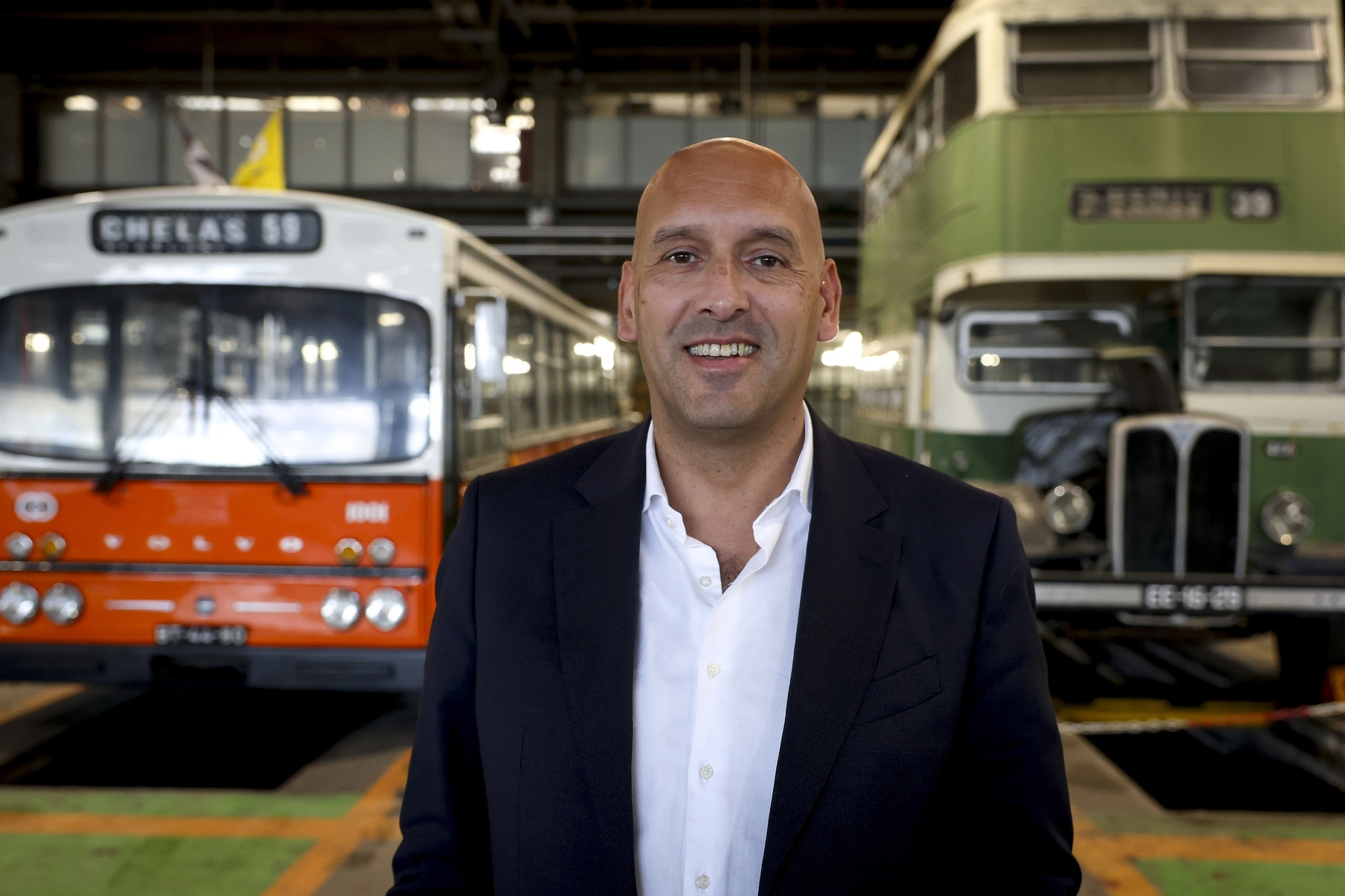
Esta semana, no Público, saiu uma entrevista com o novo presidente da Carris, onde fala de coisas curiosas como, entre outras, aumentar a rede de elétricos.
Mas o que me chamou a atenção não foi isso, mas sim a foto principal, e em particular os autocarros que estão por trás, e que me causou um enorme “ataque de nostalgia”. E eu que nem sou de saudosismos…
Do lado direito, o monstro verde de dois andares que fazia a carreira 39, subindo penosamente em direção ao Príncipe Real vindo de São Bento, mesmo perto de casa quando cresci perto da Praça das Flores, e que eu fazia questão de sentar no primeiro andar logo no banco da frente, como acho que toda a gente faz num destes.
Do lado esquerdo, o laranja que fazia a carreira 59, muito provavelmente a coluna vertebral de grande parte da zona oriental de Lisboa, numa altura pré-Expo 98 em que era uma zona cortada do resto da cidade, e que por isso mesmo era de que dependia para ir para a secundária.
Não apenas os autocarros, já de si icónicos em Lisboa, mas também as duas carreiras que mais usei no século passado quando era jovem, tudo na mesma foto.
"O direito internacional deve favorecer ditaduras?"
Na SIC Notícias um comentador diz, a propósito do ataque ao Irão, algo do género “O direito internacional deve favorecer ditaduras?”.
Na verdade, na verdade o “direito internacional” apenas favorece os interesses económicos e o equilíbrio de poder dos blocos envolvidos. Achar que o “direito internacional” se preocupa com os direitos humanos é ingénuo, ou deliberadamente alinhado com uma agenda.